The Referral Is Only the Beginning
Most behavioral health organizations track referrals. They count them, report them, and treat volume growth as a performance signal. Referral volume does matter. It reflects demand and market trust.
But it is an incomplete measure of performance.
A referral represents a moment – someone’s decision to seek help, or a clinician’s decision to connect a patient to a resource. That decision reflects readiness, motivation, or at minimum, openness. It is not a guarantee of engagement. It is an opportunity.
Whether that opportunity converts into active, sustained care depends almost entirely on what the receiving organization does next. And how quickly.
What the Engagement Window Is
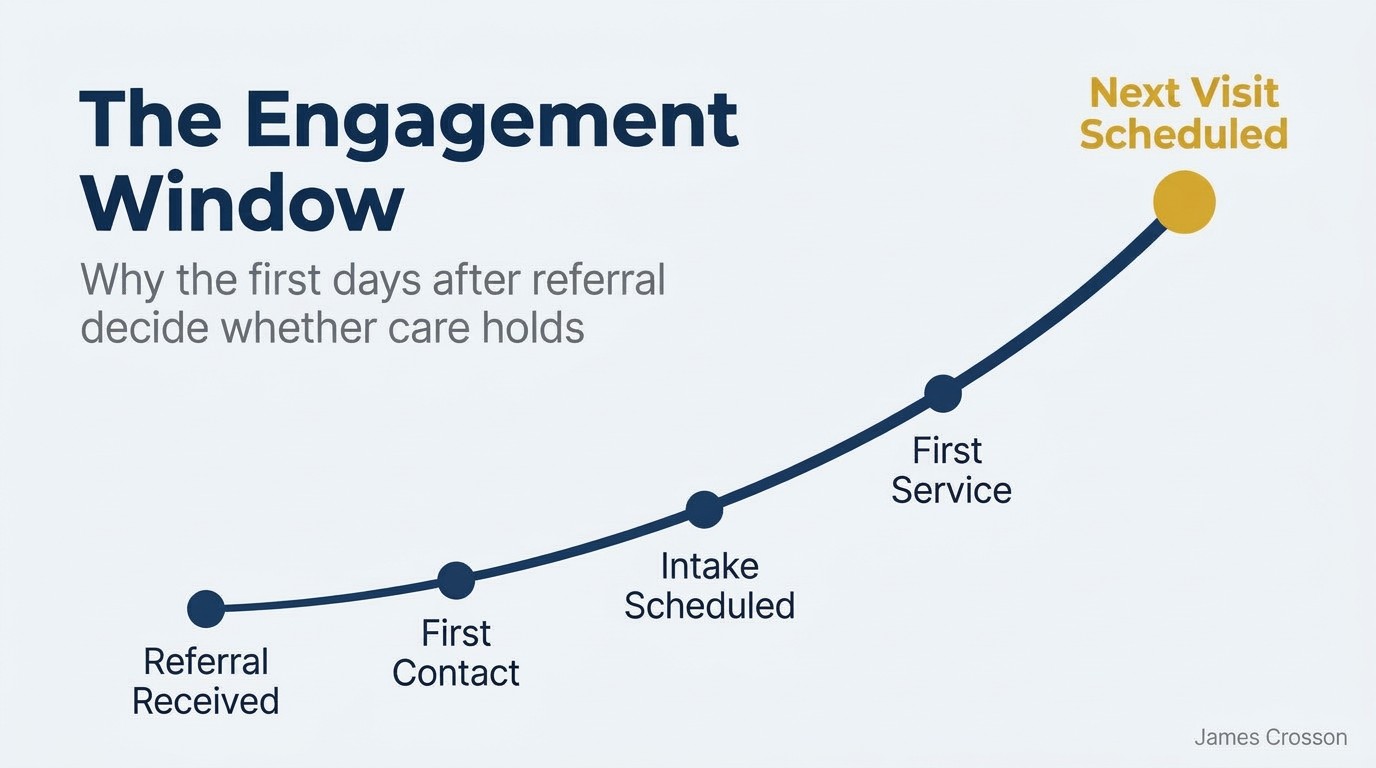
The engagement window is the period between referral and sustained participation in care. It is not a fixed number of days. It is a concept that describes something observable in practice: momentum.
When a referral arrives, several things are often true simultaneously. The client has some level of readiness. The referring source is still connected and invested. The need that prompted the referral is still present. The system has an opening.
That opening does not stay open indefinitely.
Motivation fluctuates. Life circumstances shift. When the receiving program moves slowly, the client fills the gap with whatever comes next – family pressure, crisis, discouragement, or simply moving on. The referring source stops following up. The sense of urgency fades.
I see this dynamic regularly leading a community-based psychiatric rehabilitation program. The referrals that convert most reliably are the ones where the team responded quickly, scheduled intake without delay, and left the client with a clear next step before the first interaction ended. The referrals that quietly disappear are almost always the ones where days passed without meaningful contact.
The window is real. Most programs are not designed around it.
How Engagement Breaks in the First Few Days
Disengagement after referral rarely happens loudly. There is no formal withdrawal, no call saying “I changed my mind.” It happens quietly, through accumulation of small gaps.
The intake call goes out a day or two late. The client is not reached on the first attempt and follow-up is inconsistent. Intake gets scheduled for two weeks out. The client attends intake but leaves without a first service appointment confirmed. A week passes with no contact. By the time the organization follows up again, the window has closed.
Each gap is explainable in isolation. Together, they are a system failure.
The breakdowns tend to cluster in predictable places:
- Slow or inconsistent first outreach after referral
- Long lag between referral receipt and intake scheduling
- Extended wait between intake completion and first service delivery
- Clients leaving intake without their next visit already on the calendar
- No defined accountability for tracking referral conversion in real time
None of these are motivation problems. They are operating rhythm problems. And they are addressable through system design.
This Is an Operating System Issue
Behavioral health programs often treat referral-to-engagement as a clinical and administrative sequence that unfolds naturally over time. It does not. Left unstructured, it leaks.
Research and operational experience point in the same direction (see, for example, Gallucci et al., 2005): earlier scheduling, faster contact, shorter wait times, and direct handoffs between providers all improve the likelihood that a person will connect to care and stay connected. The structure of the referral process is not a background function. It is a primary driver of whether engagement happens.
The issue is not simply speed. It is structured conversion from referral to active engagement.
Momentum has to be converted into structure. The handoff is not complete until the client is connected to the next scheduled action. When the next step is unclear, disengagement starts quietly – often before anyone notices.
Building an engagement operating system means defining the referral-to-engagement rhythm explicitly: how quickly outreach occurs, how intake is prioritized and scheduled, how first service is confirmed, and how the team tracks where every new referral stands in real time. It means treating the space between referral and first service not as a waiting period, but as an active operational zone with accountability attached to it.
What Leaders Should Measure
Behavioral health leaders should not measure referrals alone. They should measure how quickly referrals become active engagement.
The operational questions that matter:
- How long does it take to make first contact after referral?
- How many referrals are contacted within the first business day?
- How long does it take to schedule intake after referral?
- How long does it take to deliver the first service after intake?
- How many new clients leave intake with their next visit already scheduled?
- How many referrals never convert into active engagement?
These are not just access metrics. They are engagement signals.
If these numbers are not tracked, the program is managing referral volume rather than engagement performance. Those are different things. One tells you how much demand you have. The other tells you how much of it is actually converting into care.
Early Engagement Connects to Outcomes
The case for moving quickly is not only operational. It is clinical.
The evidence on post-discharge follow-up in behavioral health is consistent (Marcus et al., 2017): earlier contact is associated with meaningfully better outcomes, including lower rates of readmission and stronger continuity of care. That protective effect is not flat over time. It degrades. Earlier is better than later, and much later is often too late.
For community-based programs serving adults with serious mental illness, this matters more, not less. These are not low-complexity referrals. Many of the individuals entering care have struggled to stay connected to services before. They are exactly the population for whom the engagement window is most consequential.
The program’s operating rhythm either protects that window or wastes it.
The Leadership Takeaway
This is not an argument for working faster for the sake of speed. It is an argument for designing systems that match the nature of the problem.
Behavioral health engagement is time-sensitive. There is a period, early in the referral process, when the conditions for connection are most favorable. The client is reachable. The need is present. The referring source is still engaged. What the receiving organization does in that period either capitalizes on those conditions or allows them to erode.
Leaders should examine how their organization is designed to respond in the first hours and days after a referral arrives. They should measure it, structure it, and hold it to a standard.
A referral is not engagement. Intake is not sustained care.
What happens between the two – how fast, how clearly, and how consistently – is where programs either hold their clients or lose them.
Sources
- Gallucci G, Swartz W, Hackerman F. “Impact of the wait for an initial appointment on the rate of kept appointments at a mental health center.” Psychiatric Services, 2005. Link
- Marcus SC, Chuang CC, Ng-Mak DS, Olfson M. “Outpatient follow-up care and risk of hospital readmission in schizophrenia and bipolar disorder.” Psychiatric Services, 2017. Link