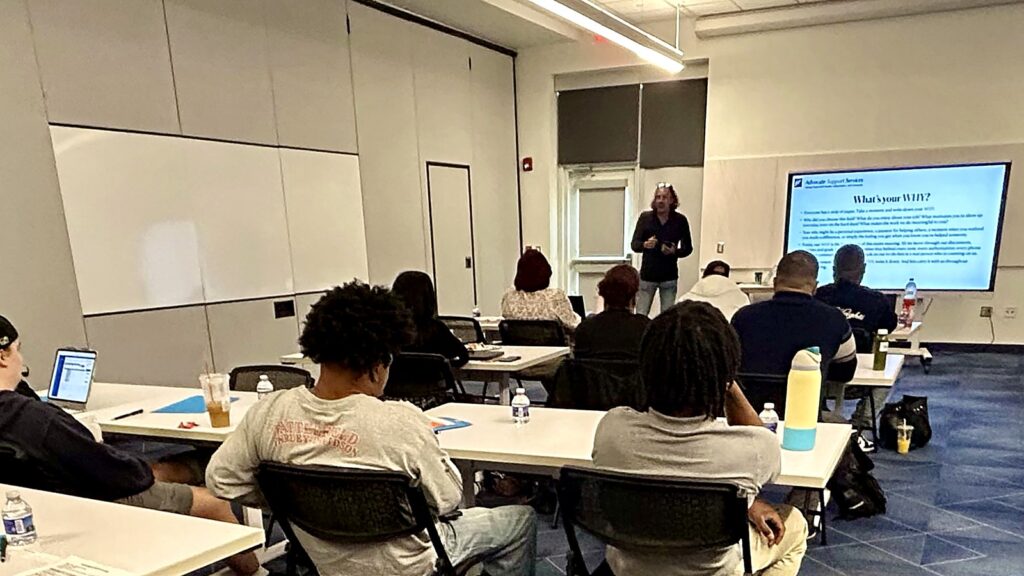
At our last all-staff meeting, every person in the room got a narrow strip of paper with one question printed at the top: What’s your why?
Afterward I laid the strips out on a table and read them one at a time. Fourteen answers, in fourteen different handwritings. Some were a single line. Some ran past the edge and curled up the margin because the writer had more to say than the paper allowed.
I’ve led this organization for 25 years. I thought I knew why people come to work here. Reading those strips, I learned something more useful: what they didn’t write.
What They Wrote
The answers fell into a few clear patterns.
- Making a difference. The most common thread by far. Helping someone reach a goal. Putting a smile on a face.
- Lived experience. Four people traced their why back to their own families, to what they grew up around, or to help they once received. One wrote about “paying it forward like it was done for me.”
- Connection. One person described the moment “when a client finally trusts you enough to open up.”
- Something bigger. Compassion. Faith. “Breaking the stigma around mental health.”
- The workplace itself. One person wrote about wanting a company with a clear vision and good relationships between leadership and staff. I read that one twice.
This is the fuel of community behavioral health. It’s why people drive to a third home visit on a rainy afternoon for a client who may not answer the door.
What Nobody Wrote
Not one strip said “closing my progress notes within 24 hours.” Nobody’s why was forward scheduling, or chasing an authorization before it lapses, or getting a release of information signed before a hospital discharge.
Yet that is what most of the meeting was about. How a referral becomes an intake. How an intake becomes a first visit within 24 hours. How a note connects a visit to a client’s goals. How a missed appointment gets followed up instead of quietly becoming a disengaged client.
It would be easy to see two different meetings here. A heart meeting and a paperwork meeting. I don’t think that’s right.
Systems Protect the Why
Purpose is the fuel. Systems are the engine. Fuel without an engine just burns.
Every staff member who wrote “I want to make a difference” is depending on systems they will never see on a strip of paper:
- A referral that gets a call back in hours, not days, so the person who asked for help is still there to receive it.
- A schedule that is already set, so a client knows when someone is coming.
- An authorization renewed on time, so services don’t stop for reasons the client never understands.
- A note closed the same day, so the next person on the team knows what happened.
When those systems fail, the why doesn’t disappear. It gets spent. Good people cover the gaps with extra calls, late nights and personal heroics. That works for a while. Then it doesn’t, and we call it burnout. (I wrote more about that pattern in Systems Over Heroics: Why Good Organizations Burn Out Their Best People.)
A missed authorization is not a paperwork problem. It’s a promise to a person that didn’t get kept. The system is how we keep the promise that the why makes.
I Didn’t Run This Session
One more detail matters. I didn’t lead the “What’s your why?” exercise. Our Executive Director, Donna Phillips, and our leadership team designed it and ran it. I gave my monthly report and then sat back and listened.
That is the point. If the CEO has to be in the room for purpose to show up, purpose is a personality, not a system. When a leadership team connects the why to the work without being asked, the culture is starting to run itself.
That’s the kind of organization I want to build. One where nobody, including me, has to be the hero.
The Question for Leaders
Your staff already have a why. You don’t need to give them one. Your job is to build an operating system that honors it instead of draining it.
So here’s a test. Pull your staff’s why statements, or ask for them. Then look at your workflows. Does each process make it easier for people to do what they wrote down, or harder?
Purpose gets people in the door. Systems are what keep them there, and what keep our clients with us too.
What’s one system in your organization that protects your team’s why, or one that’s quietly draining it?